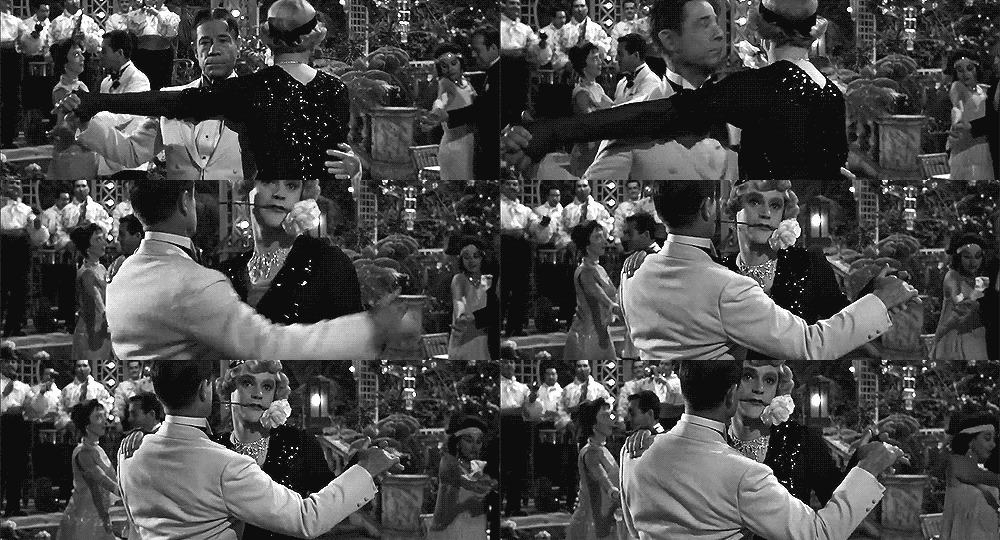
I wrote this essay for my Media Studies: History class, where we were asked to compare two scholarly articles on a single issue in film history. I chose to focus on queer visibility during the Production Code era because I’ve always been drawn to the ways queer meaning survives erasure. Even when Hollywood tried to suppress it, people found ways to express themselves through gesture, tone, chemistry, and subtext. This essay traces that resilience and how it still shapes the way I watch classic films today.
The Production Code might have been written to keep Hollywood “moral,” but what it really did was force people to get creative. For more than three decades, it banned “sexual perversion,” the industry’s euphemism for queerness, from American screens. Writers, directors, and actors were not allowed to acknowledge it, yet queerness never disappeared. It adapted. It survived through movement, tone, and chemistry, building a quiet history in the margins. Two film scholars, Chon Noriega and David Lugowski, examine how this censorship shaped queer storytelling, but they reach very different conclusions. Noriega argues that queerness was erased so completely that it left films hollow, while Lugowski sees it as something that evolved, hidden, transformed, but still visible. Together, their ideas show that the Production Code didn’t erase queerness; it simply gave rise to another one. In trying to police meaning, Hollywood ended up creating a new system of expression entirely, a queer code built from glances, rhythm, and wit.
Chon Noriega’s “Something’s Missing Here!” explores what happened when studios adapted explicitly queer plays and novels during the height of the Code. He focuses on the void left when that material was cut out and on how critics tried to talk around what they weren’t allowed to name. In films such as The Children’s Hour, Tea and Sympathy, and Cat on a Hot Tin Roof, the removal of queerness did not make the stories safer; it made them strange. The motivations disappeared, leaving emotional confusion behind. Noriega calls this a “visible absence,” where the hole created by censorship becomes impossible to ignore. He points to reviews that relied on coded language like “artistic,” “sensitive,” or “unusual.” Those euphemisms, whether they were common before the Code or not, became part of queer history afterward. His method, part discourse study and part cultural history, shows how silence itself became a kind of expression. Under this system, the absence of queerness became one of the ways audiences learned to find it.
David Lugowski, in “Queering the (New) Deal,” offers a more hopeful view. His research focuses on the early years of the Production Code, before enforcement was quite as strict, and finds queerness hiding in disguise. He examines films like Morocco (1930) and Queen Christina (1933), films that used charisma and innuendo to slip gender fluidity and desire past censors, showing that Hollywood was still creating some of its most subversive early queer imagery. For Lugowski, these works prove that queer identity endured by learning to perform within the rules, using humor, costume, and tone as tools of expression. His approach combines film history with social context, showing how queer-coded archetypes such as the effeminate man, the mannish woman, and the elegant bachelor became their own language.
So Lugowski finds performance where Noriega finds silence, and both reveal how queer meaning persisted through expression, on-screen and in the audience’s act of recognition. The difference between them is as much about perspective as it is about time. Noriega focuses on what happens when queer expression is forcibly removed, while Lugowski studies how it hides in plain sight. Noriega’s queerness exists in the silence of the 1950s and Lugowski’s in the playfulness of the 1930s. Yet the two arguments connect through what they reveal about resilience. As queerness shifted from open representation to coded expression, audiences had to learn how to understand it differently. Queer viewers, already fluent in this language, found pieces of themselves in what others missed, while straight audiences learned to read the same cues, often without realizing it. In the end, even with all its power, the Production Code didn’t manage to erase queerness. Instead, it spread it through quiet education, teaching people how to look for what wasn’t meant to be seen. Over time, that act of looking became a shared cultural literacy, one that taught audiences to recognize what had been deliberately obscured.
For example, when read through the same interpretive lens that the Code trained audiences to develop, Singin’ in the Rain (1952) reveals more than it first appears to. It isn’t just a love story between two people; it’s really about three. It’s a trio bound together by rhythm, laughter, and a kind of affection that feels like love even when it isn’t named as such. Their connection carries the warmth and tension of romance but without the need to declare it, living instead in gesture, movement, and shared breath. Don, Cosmo, and Kathy’s relationship resists the usual triangle-related hijinks of jealousy or competition. Instead, it’s marked by a kind of mutual devotion that feels both joyful and deeply queer. Once you notice it, the film feels different. Something unspoken comes into focus.
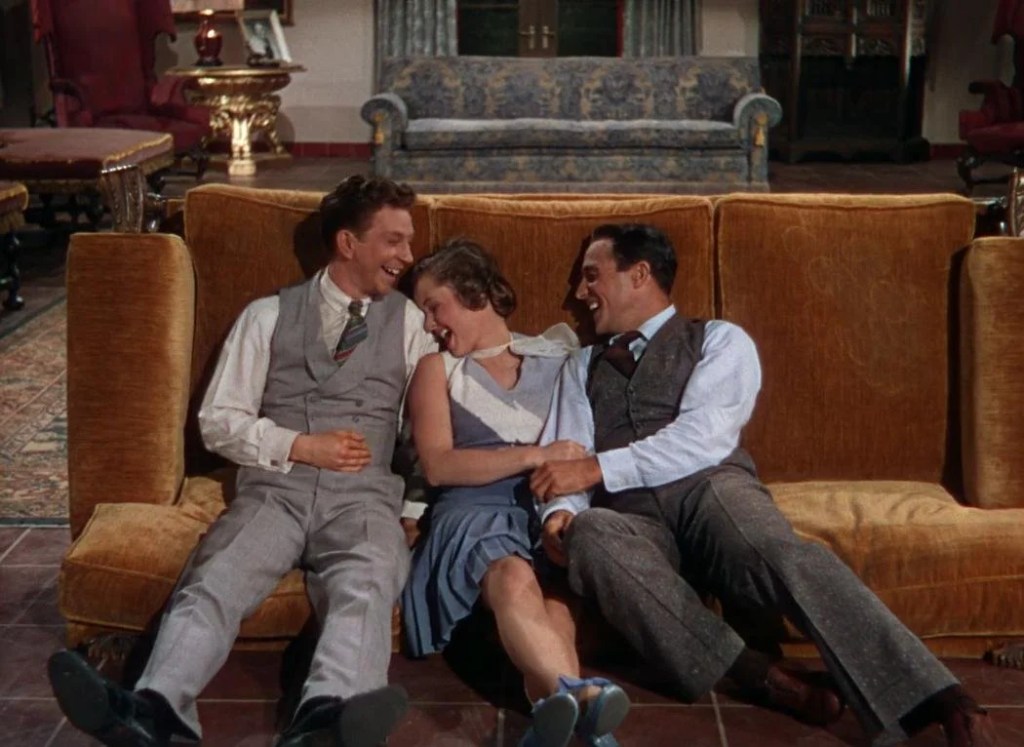
This is not fan speculation but a continuation of the same reading practice the Code itself created. The laughter, the partnership, and the joy all belong to the same history of queer endurance that survived by being read differently. To look for queerness in moments like this isn’t just analysis. It’s part of the same act of recognition that kept these stories alive. Seeing it becomes a way of continuing that survival.
That is the paradox both Noriega and Lugowski reveal. The Code sought to silence queerness but ended up proving its persistence. Noriega finds queerness in absence; Lugowski finds it in adaptation. Both are right. Together, they show that queer film history is not only a story of loss but also of reinvention. The Production Code muted the words, yet the language that grew in their place continues to speak. Queerness was never gone. It simply learned new ways to be seen.
Works Cited
- Donen, Stanley, and Gene Kelly, directors. Singin’ in the Rain. MGM, 1952.
- Lugowski, David M. “Queering the (New) Deal: Lesbian and Gay Representation and the Depression-Era Cultural Politics of Hollywood’s Production Code.” Cinema Journal, vol. 38, no. 2, 1999, pp. 3–35. JSTOR, http://www.jstor.org/stable/1225622.
- Noriega, Chon. “‘Something’s Missing Here!’: Homosexuality and Film Reviews during the Production Code Era, 1934-1962.” Cinema Journal, vol. 30, no. 1, 1990, pp. 20–41. JSTOR, https://doi.org/10.2307/1224848.
- Wilder, Billy, director. Some Like It Hot. United Artists, 1959. Film GIF

 Reed Writes
Leave a comment